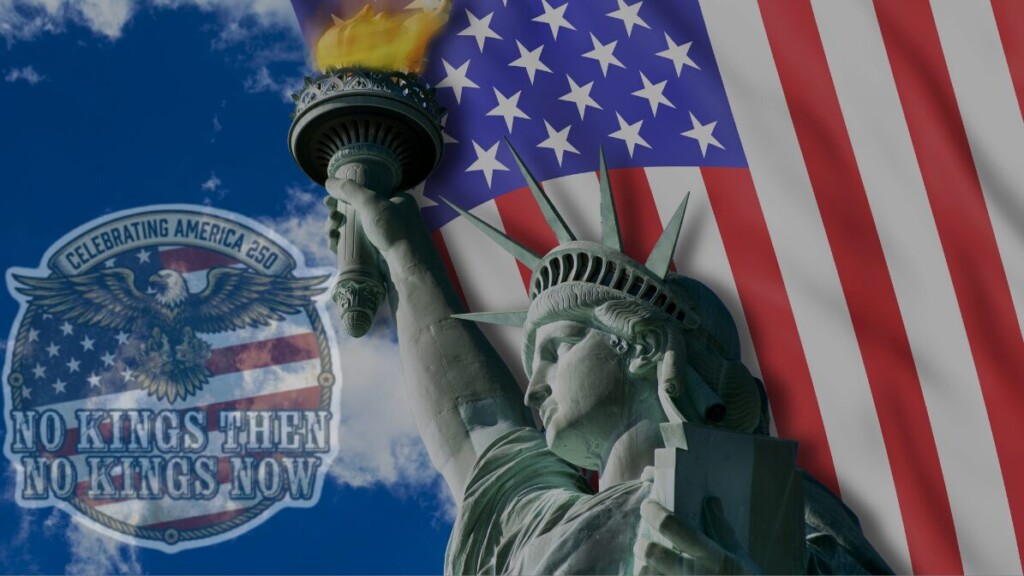
America is turning 250 years old.
Two hundred and fifty years of being a country. Two hundred and fifty years of the founding story — the one where a group of people looked at a king, looked at each other, and collectively decided: no. Not here. Not us. Not anymore.
It’s a good story. I genuinely like parts of it. The audacity of it. The nerve it took to put certain words on paper and then sign your actual name to them.
The problem — and there is always a problem when you look at American history honestly — is that the freedom story was never meant for all of us. The people who wrote “all men are created equal” owned other people. The founders who declared independence from a tyrant turned around and built systems that would spend the next two and a half centuries determining, category by category, which humans counted as fully human.
Women: not yet. Black people: definitely not. Disabled people: not for a very long time, and apparently, not without a fight that never actually ends.
I’m autistic, I’m nonbinary, I’m trans, and I have disabilities. I exist at the intersection of several categories of people that this country has spent recent years actively debating — in courts, in Congress, in executive orders, in DOJ memos quietly dropped on a Friday afternoon — whether they deserve full participation in public life.
So when July 4th rolls around and everyone’s doing the fireworks and the barbecue and the flags, I’m over here doing a different kind of accounting. Not because I don’t love this country, or at least the version of it that’s possible. But because I refuse to celebrate the myth of freedom while the reality of it is being stripped from people like me in real time.
Let me tell you what’s actually happening. Because a lot of people don’t know. And not knowing is something they’re counting on.
The DOJ Just Quietly Tried to Send Disabled People Back to Institutions
On June 18, 2026 — just days before the 27th anniversary of one of the most important disability rights decisions in American history — the Department of Justice’s Office of Legal Counsel released a memo.
If you didn’t hear about it, that’s not an accident. It didn’t make the front page. Didn’t trend. It was released on a Friday, as these things tend to be when the people releasing them would prefer you not look too closely.
The memo reinterprets the Olmstead v. L.C. decision — a 1999 Supreme Court case that is widely considered the most significant disability rights ruling since the ADA was signed. Olmstead established what’s known as the “integration mandate”: the principle that people with disabilities have the right to receive services in their communities, in their homes, with their families, rather than being warehoused in institutions. For nearly 30 years, Olmstead has been used to expand access to community living, integrated employment, and inclusive services for people with disabilities across the United States.
The DOJ’s new memo argues — and I want you to really sit with the audacity of this — that Olmstead didn’t actually mean what every court, every administration of both parties, every disability rights organization, and every legal scholar has understood it to mean for 27 years. The memo argues that states do not have to provide in-home or community-based care to people with disabilities who need support.
The memo even admits this is a stretch. It acknowledges its unusual position, noting “we recognize that this view of Olmstead’s import is out of step with the common understanding of that decision within the federal courts.”
Let me translate that.
They are saying: we know this contradicts decades of established law. We’re saying it anyway.
The DOJ just gave the White House and other federal entities a green light to take disabled people back to a time when the state could, at any time, strip them of their homes, families, autonomy, and their lives.
And in case you think “institution” sounds abstract and historical: disabled people will never forget that those institutions were phased out beginning in the 1970s in many states because they were found to be horrific, harmful, and even deadly. Individuals with disabilities were forced to live in filthy, overcrowded conditions, and subjected to eugenic experiments, forced sterilizations, and other violations of their fundamental dignity as human beings.
This is not ancient history. This is my community’s living memory. And they’re trying to open the door back to it.
The ACLU was direct: “Trump’s Justice Department cannot erase federal laws and decades of legal precedent with a single opinion. This is a blatant attempt to undermine the rights of disabled people.”
The memo doesn’t have the force of law. The ADA still exists. Olmstead still exists. But rights mean less when the federal government refuses to enforce them.
And Then There’s the Money
The DOJ memo didn’t land in a vacuum. It landed on top of something else that’s already in motion.
According to the nonpartisan Congressional Budget Office, President Trump’s One Big Beautiful Bill Act will slash more than a trillion dollars in federal spending from Medicaid and the Children’s Health Insurance Program by 2034.
Medicaid covers more than 40 million people with disabilities in the United States, and a significant share of their access to community living, personal care, and support services runs through this funding.
Home health aides. Day services. Supported employment. Residential support. The programs that allow disabled people to live in their communities rather than institutions. These are what’s called “optional” under federal law — meaning states are not required to offer them, and they can reduce or eliminate them more easily than mandatory benefits.
The administration says there are no cuts to Medicaid.
The Congressional Budget Office — which is nonpartisan and does math for a living — says otherwise. Disability advocates say: “Make no mistake: this bill will cause direct harm to anyone who depends on Medicaid to continue living in their community.”
So. A DOJ memo that says states don’t have to provide community-based services to disabled people. And nearly a trillion dollars in Medicaid cuts that fund the community-based services that allow disabled people to live outside of institutions. At the same time.
These are not two separate things happening in parallel. This is a coordinated dismantling. The memo gives states the permission. The funding cuts give states the excuse. And the people who get hurt are the ones who were already navigating the most inaccessible systems in the country before any of this started.
One mother described it this way: “I feel like I’m always trying to prove their worth, to prove their value, and it’s exhausting.”
Yeah. It is. And we’ve been doing it for a long time.
This Is Happening to Trans People Too. Simultaneously.
In case anyone thought “maybe it’s just the disability stuff” — it is not just the disability stuff.
President Trump campaigned against trans people specifically, spending millions of dollars on anti-trans ads. Since taking office, the administration has rolled back protections for and access to gender-affirming care.
FEHB issued a letter to carriers stating that beginning plan year 2026, carriers should not cover surgical or hormonal gender-affirming care — which means the federal employees who happen to be trans are watching their health coverage rewritten around their identities.
As of 2026, 27 states have enacted some form of ban on gender-affirming care for minors. Twenty-seven. And in March 2026, the United States Court of Appeals for the Fourth Circuit ruled that West Virginia may continue to prohibit gender-affirming procedures for adults from being covered by Medicaid.
Adults. Not just kids. Adults, being told that the healthcare that relates specifically to their identity is not covered.
The government has abandoned LGBTQ+ workers. Trans people and people of color have been quietly erased from national caregiving plans. Health insurance costs are up and women and LGBTQ+ people are paying the price.
I am autistic and trans and nonbinary. There is no version of this political moment where some of the things being done don’t affect me personally. This isn’t abstract policy for me. This is my healthcare. My legal protections, my right to exist in my community rather than in an institution, and my kids’ right to have a parent who is supported rather than institutionalized.
This is Tuesday.
The Part About What Freedom Actually Means
Here’s what I keep coming back to when I think about America turning 250.
The people who founded this country — again, deeply flawed, I’m not running a PR campaign for them — understood something that the current administration appears to have forgotten. Or maybe they haven’t forgotten. Maybe they just never believed it applied to people like me.
They understood that freedom is not the absence of government. It’s the presence of protection from power. From the power of a king, yes. But also from the power of a state that decides certain people’s bodies and brains and identities are inconvenient enough to warehouse, to legislate away, to strip of services until community living becomes impossible.
No kings meant no unchecked power. No single person or entity deciding who counts and who doesn’t. It meant accountability. It meant that the people being governed got a say in the governing.
I am being governed right now in ways I did not consent to, by an administration that has made very clear it does not consider my communities’ voices relevant to the decisions being made about our lives.
That’s not freedom. That’s a king wearing a different hat.
No kings then. No kings now.
What You Can Actually Do (Because I Know You’re Going to Ask)
First: know what’s happening. The fact that you read this far means you care, and caring starts with knowing. Share what you know. The DOJ memo slipped by most people. The Medicaid cuts are complicated enough that a lot of people don’t understand the disability-specific impact. Explain it. Use plain language. Send people links. Be the person in your circle who makes it impossible to claim ignorance.
Second: contact your representatives. Not the form-letter version. A real call, a real email, a real letter from a real person who actually votes. State-level matters enormously right now, because many of these Medicaid fights are being decided at the state level. Find your state legislators and tell them specifically what you want them to protect.
Third: support the organizations doing the legal work. The ACLU. The Arc. The AAPD. The Disability Rights Education and Defense Fund. These are the organizations bringing the cases, filing the responses, doing the advocacy that the federal government has abdicated. They need resources to keep going.
Fourth — and yes, I’m going to say this — wear the thing. Put the sticker on your car. Get the mug. Have the hoodie that makes your uncle at the July 4th cookout want to start a conversation, and be ready to have it.
America 250: No Kings Then, No Kings Now! collection
The America 250: No Kings Then, No Kings Now! collection exists because sometimes advocacy is a flag you wave in a coffee shop or a park on the Fourth of July. Sometimes it’s a conversation that starts because someone reads what’s on your shirt. Sometimes it’s just making yourself visible as a person who is paying attention, who is not okay with this, and who is not going to pretend the birthday party is fine while the house is on fire.
Hats. Hoodies. T-shirts. Mugs. Tote bags. Stickers. Throw pillows for the passive-aggressive home décor enthusiast in your life. Every purchase supports this page and the advocacy work that happens here. Which, right now, I’m not going to pretend is separate from survival. It isn’t.
A Note Before I Go
I want to be clear about something.
I love this country. Not uncritically, not blindly, and not in the way that requires me to ignore what’s being done to people I love. But I love the idea underneath the founding — the stubborn, defiant, we-are-not-doing-this idea that power should answer to people, not the other way around.
That idea belongs to all of us. It belongs to the autistic kid who can’t access community services. To the trans adult whose healthcare just got legislated away, to the disabled person watching a DOJ memo threaten the legal protection that keeps them out of an institution, and to every person who has ever had to fight for the right to exist in their own country as their full selves.
The founders — their words, not their full practice, because their practice was a catastrophe for a lot of people — said this country was for everyone. We’re still trying to make that true. We’ve been trying since 1776. We’re still trying.
Two hundred and fifty years.
No kings then. No kings now.
And we’re not going anywhere.
Want to support this work? → Shop the America 250: No Kings collection → Browse Advocacy Merch → Donate to Just 1 Voice → Read more about disability rights on this site